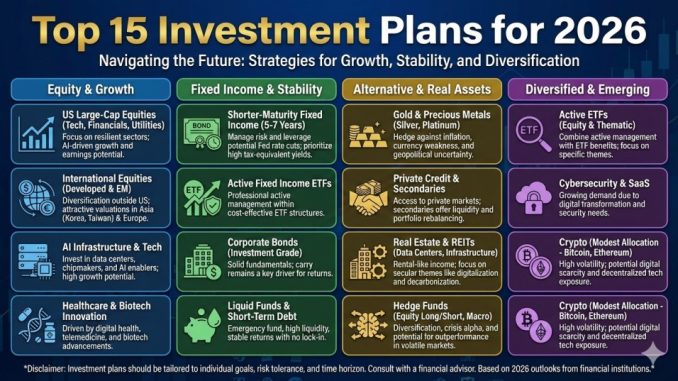
2026 is shaping up to be a very important year for investors. Inflation pressure, changing interest rates, AI-driven businesses, and new government policies are all going to impact where money should be invested. If you’re still depending only on savings accounts or random tips from social media, you’re already behind.
This article is written for real people — salaried employees, freelancers, business owners, beginners, and long-term investors — who want clarity, safety, and growth in 2026.
Let’s break down the Top 15 Investment Plans for 2026, explained in simple language with practical use cases.
This article is written for real people — salaried employees, freelancers, business owners, beginners, and long-term investors — who want clarity, safety, and growth in 2026.
Let’s break down the Top 15 Investment Plans for 2026, explained in simple language with practical use cases.
1. Equity Mutual Funds (Long-Term Wealth Builder)
Equity mutual funds remain one of the best investment options for 2026 if your goal is wealth creation over 5–10 years.
With India’s economy expanding, consumption rising, and corporate profits improving, equity markets are expected to perform well in the long run.
Best for:
- Long-term investors
- Salaried people doing SIP
- Investors beating inflation
Expected Returns: 10–14% annually (long term)
Pro Tip: Go for index funds or large-cap funds if you want stability, and mid-cap funds if you can handle some risk.
2. SIP (Systematic Investment Plan)
SIP is not a product; it’s a method — and one of the smartest ways to invest in 2026.
Instead of timing the market, SIP allows you to invest a fixed amount monthly, reducing risk and emotional decisions.
Best for:
- Beginners
- Salaried employees
- Long-term discipline investors
Minimum Investment: Starts from ₹500/month
Why SIP Works in 2026:
Markets will remain volatile, and SIP benefits from rupee cost averaging.
3. Direct Stock Market Investment
If you understand businesses, financials, and market cycles, direct equity investing can outperform most other options.
In 2026, sectors like AI, renewable energy, defense, banking, EV, and digital infrastructure are expected to grow strongly.
Best for:
- Experienced investors
- High-risk takers
Expected Returns: 12–18% (with skill)
Warning: Never invest blindly based on Telegram or YouTube tips.
4. Public Provident Fund (PPF)
PPF is still one of the safest and most tax-efficient investments in India.
In uncertain times, capital protection matters, and PPF gives guaranteed returns backed by the government.
Lock-in: 15 years
Tax Benefit: EEE (investment, interest, maturity all tax-free)
Best for:
- Risk-averse investors
- Long-term retirement planning
5. National Pension System (NPS)
NPS is becoming more attractive every year, especially for retirement planning.
With additional tax benefits under Section 80CCD(1B), NPS is a smart choice for people planning retirement beyond 60.
Best for:
- Salaried professionals
- Long-term retirement planners
Extra Tax Benefit: ₹50,000 over 80C
6. Fixed Deposits (FDs)
FDs may not give the highest returns, but in 2026 they still play a role in capital safety and emergency funds.
With interest rates expected to stay moderately high, FDs can provide stable income.
Best for:
- Conservative investors
- Senior citizens
Expected Returns: 6–7.5%
7. Real Estate (Selective & Smart)
Real estate is no longer about buying anything anywhere. In 2026, location, rental yield, and liquidity will decide success.
Tier-2 cities, commercial properties, and rental-focused assets are gaining attention.
Best for:
- High-capital investors
- Long-term asset holders
Avoid: Over-leveraged or speculative purchases.
8. REITs (Real Estate Investment Trusts)
REITs allow you to invest in real estate without buying property.
They offer rental income, diversification, and better liquidity compared to traditional real estate.
Best for:
- Income-focused investors
- Small investors wanting real estate exposure
Expected Returns: 8–12%
9. Gold (Digital & ETFs)
Gold remains a crisis hedge and portfolio stabilizer.
Instead of physical gold, digital gold and gold ETFs are better for transparency and liquidity in 2026.
Best for:
- Risk hedging
- Portfolio diversification
Allocation Tip: 10–15% of total portfolio
10. Sovereign Gold Bonds (SGBs)
SGBs are one of the smartest gold investments available.
You get gold price appreciation + 2.5% annual interest, and maturity gains are tax-free.
Lock-in: 8 years
Best for: Long-term gold investors
11. Debt Mutual Funds
Debt funds are useful when interest rates stabilize.
They offer better tax efficiency than FDs for higher tax-bracket investors.
Best for:
- Short- to medium-term goals
- Conservative portfolio balance
12. ULIPs (Modern, Low-Cost Only)
Old ULIPs were bad, but new-age ULIPs with low charges can work for disciplined long-term investors.
Best for:
- Long-term goals (10+ years)
- Insurance + investment combo
Avoid: High-charge traditional ULIPs.
13. Government Bonds & Treasury Bills
If safety is your top priority in 2026, government bonds are reliable.
They may not beat equity returns, but they protect capital and provide predictable income.
Best for:
- Risk-averse investors
- Capital preservation
14. International Mutual Funds
Global diversification is becoming essential.
Investing in US, Europe, and global tech funds reduces dependence on a single economy.
Best for:
- Diversification seekers
- Long-term global exposure
Tip: Keep allocation under 15–20%.
15. High-Interest Savings & Liquid Funds
For emergency funds and short-term parking of money, liquid funds and high-interest savings accounts are ideal.
They offer flexibility, safety, and instant liquidity.
Best for:
- Emergency corpus
- Short-term goals
Final Thoughts: How to Invest Smartly in 2026
There is no single best investment plan. The best strategy for 2026 is a balanced portfolio:
- Equity for growth
- Debt for stability
- Gold for protection
- Liquidity for emergencies

Leave a Reply